
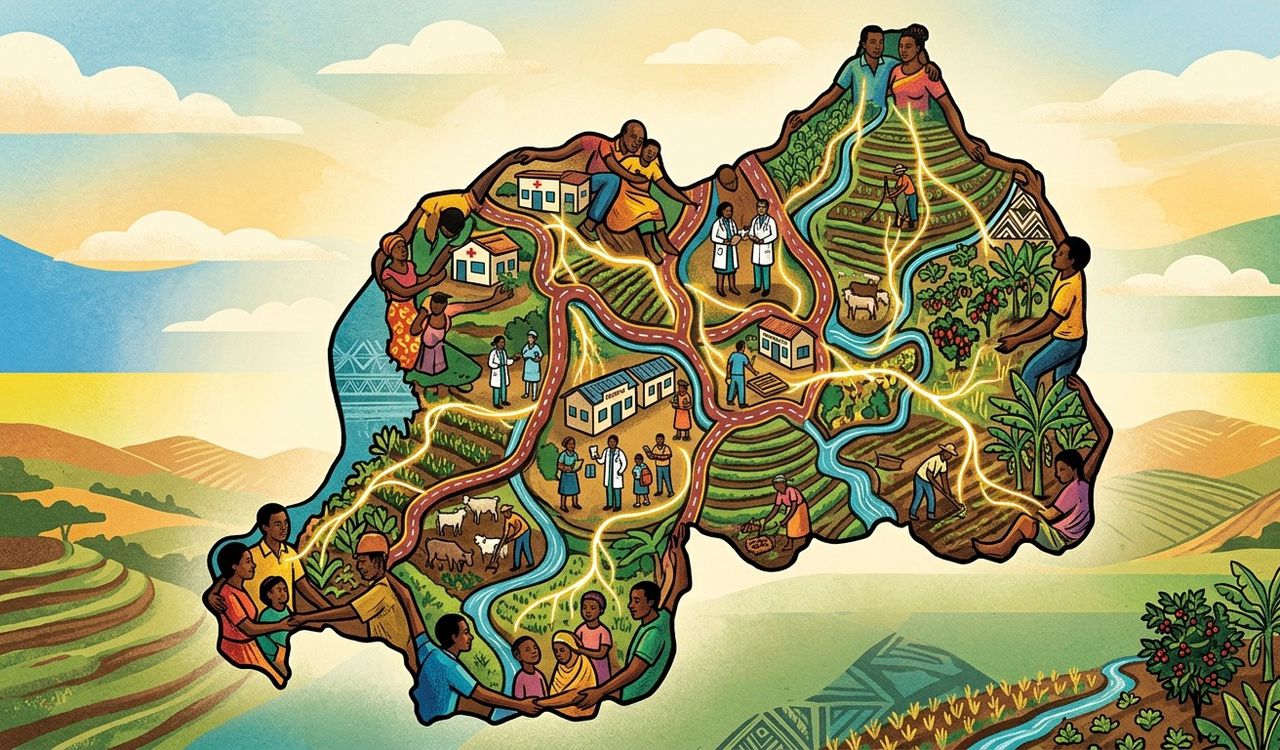
The mist comes first, rolling down the hills around Nyanza, clinging to the banana plantations.
Akariza wakes before dawn. She ties her youngest, Manzi, to her back with a length of cloth. The path to the Nyanza district hospital is two kilometers of brown dirt. At the hospital, the nurse does not ask her name. The nurse already knows her. Her village. Her children. Whether she has paid her mutuelle de santé. Manzi is due for his next shot in three weeks. On her way home, she thinks of the Imihigo ceremony she heard on Radio Rwanda at the start of the year, when her mayor stood before the President and pledged to build roads and classrooms. If he fails, the rankings will come out, and he will be called to explain. Later, a neighbor tells her the President is coming. Citizens can ask questions directly. Akariza sits on her steps. The irrigation system promised three years ago has not arrived. Now she can ask someone who can actually make things happen.
Now ask yourself: is this democracy?
If you are a Western journalist, a policymaker, or a civil society veteran, your instinct might be to hesitate. You are familiar with a different model: opposition parties, investigative journalism, parliamentarians trading insults. These things exist in Rwanda too, though not in the forms you are used to. This is not a rejection of the Western democratic model. That model has its own logic, its own achievements. But Rwanda has built something alongside it, something drawn from its own history, its own traumas, its own cultural traditions. The question is not which model is better. It is whether we are willing to understand a different model on its own terms.
For three decades, the world has been using the wrong tools to understand Rwanda. That blindness is costing us.
The Problem with a Single Toolkit
The standard toolkit for measuring democracy is built around inputs and procedures: elections, party competition, press freedom, civil society independence. These matter. In countries with long institutional histories, they are essential components of accountability. But they are not the only ways to hold power accountable. And in many parts of the world, they are not even the most effective ways.
Rwanda has built a system where accountability runs through delivery, not just opposition. Where legitimacy comes from competence alongside contestation. Where the social contract is shaped by a shared understanding: the state provides security, infrastructure, and basic services. In return, citizens participate in the national project of rebuilding and development that has defined the country since the 1994 Genocide against the Tutsi.
You can call this authoritarian. Many do. But then you have to explain the numbers. Since 2001, poverty in Rwanda has fallen from 60 percent to 27 percent. Electricity access has risen from 34 percent to 72 percent. In the poorest households, electricity access jumped from 9 percent to 53 percent in just seven years. When the National Institute of Statistics released these figures in 2024, the director general said simply: "The programmes being implemented are well-targeted and are reaching the people who truly need them."
In Botswana, often hailed as Africa's oldest democracy, poverty reduction has been slower than in Rwanda. In Kenya, with its vibrant opposition and robust press, life expectancy is 63 years; in Rwanda, it is 69. In Nigeria, with its raucous political competition, maternal mortality is 1,047 per 100,000 live births; in Rwanda, it is 248. These comparisons are not endorsements. They are invitations to ask a harder question: what if the things we measure are not the only things that matter to ordinary citizens?
What Civil Society Might Not Want to Hear
In Rwanda, the role of civil society has evolved into something unfamiliar to the Western-trained eye. Many organizations that once positioned themselves as external watchdogs have become embedded in the national project of delivery. They run health programs,contribute to national peace programs, manage agricultural services and even coordinate water infrastructure. They are partners in implementation, working alongside the state while maintaining advocacy functions where appropriate.
This is often called co-optation. But there is another way to understand it. Across Africa, the tidy separation between state and civil society has always been more aspiration than reality. In contexts where citizens judge governments by results alongside process, organizations that deliver tangible services build legitimacy in ways that organizations usually just issuing statements sometimes do not. The abstract right to criticize matters. So does the concrete experience of a road that connects your village to the market.
Consider the most celebrated civil society movements in recent African history. The anti-apartheid struggle in South Africa was not merely a watchdog movement. It was a parallel government. The United Democratic Front and its affiliates ran clinics, established schools, organized food distribution, and created systems of justice in townships where the apartheid state was viewed as illegitimate. They built legitimacy through doing, not just through speaking. The same was true in Nigeria during the transition from military rule. Organizations like the Campaign for Democracy and the National Association of Nigerian Students coordinated food distribution, ran legal aid clinics, and provided medical assistance to victims of state violence. They were parallel governments as much as they were advocacy groups.
Rwanda has taken this logic seriously. The question is not whether civil society should advocate. It is whether advocacy divorced from delivery can claim the same depth of legitimacy as advocacy rooted in tangible impact.
This is not an argument for shrinking civic space. It is an observation that the liberal assumption that civil society must stand outside the state to be legitimate is culturally specific. In a country that survived the 1994 Genocide against the Tutsi, where the manipulation of civic associations like mouvement social muhutu and APROSOMA was part of the machinery that enabled mass violence, the relationship between civil society and the state is necessarily more complex. Trust is built slowly. Institutions are viewed through the lens of what they delivered when everything fell apart.
None of this means Rwanda has solved democracy. There are two tensions in the Rwandan model that no honest observer can ignore.
The first is legibility. Rwanda has built a state that can see its citizens with extraordinary clarity. It knows who is poor ( ubudehe ), who is sick and who needs help. This is how it delivers services so efficiently. But a state that knows you well enough to help you is also a state that knows you well enough to watch you. Dissent becomes hard to conceal. Efficiency comes at the cost of anonymity. And anonymity is often the condition of freedom.
Here is a thought that should unsettle you. In the United States, the state does not know who is poor. Its welfare programs are fragmented across 50 separate systems with conflicting eligibility rules. In Vermont, a child welfare information system built in 1983 still operates, so outdated that the state cannot determine how much federal funding it has lost. The Earned Income Tax Credit reaches only 80 percent of eligible households, leaving 5 to 7 million families unserved each year. The price of privacy and decentralization is that the state is often incapable of helping those who need it most. Rwanda has chosen the opposite trade-off.
The second is the boundary of debate. Rwanda has drawn a line around ethnicity and national unity. On one side, vigorous debate about economic policy and development priorities. On the other, silence. This is post-traumatic logic. It is not irrational. But a society that cannot debate its deepest divisions in the open may contain them, but it does not resolve them.
Consider South Africa, which took the opposite path. It built a democracy on open debate, truth commissions, and constitutional rights. The Truth and Reconciliation Commission was internationally hailed as a model. But thirty years later, its reputation is tarnished at home. Of the 300 cases the TRC recommended for prosecution, only a handful were pursued. Political interference blocked prosecutions. The Zondo Commission on state capture cost nearly R1 billion but resulted in zero successful prosecutions. The Marikana Commission produced no senior officials held accountable. South Africa debates everything but delivers far less. It is, by any liberal measure, a more competitive democracy. It is also the most unequal country in the world, with unemployment exceeding 30 percent and violent crime among the worst globally. Which trade-off would you choose?
What Journalists and Policymakers Often Miss
For international journalists and policymakers, Rwanda presents a crisis of measurement. Democracy indices are designed to catch the absence of competition, not the presence of trust, safety, or material progress. So Rwanda scores poorly on Freedom House and V-Dem, even as its citizens report high levels of satisfaction. . According to the 2024 Afrobarometer survey, 82 percent of Rwandans trust their government. In the United States, that figure hovers around 40 percent. In the United Kingdom and in France, it is lower. What does it mean when citizens of a country labeled authoritarian trust their government more than citizens of the world's oldest democracies trust theirs? Perhaps it means trust is not a function of electoral competition alone. Perhaps it means legitimacy is built on something else entirely.
The uncomfortable possibility is that Rwanda is not a deviation from a universal model. It is a different model altogether. You do not have to prefer it. But if you cannot understand it, you cannot engage with it.
What then does Rwanda Teach us ?
Rwanda teaches that accountability can be built through delivery, not only through opposition. That legitimacy can be earned through competence alongside contestation. That citizens may value a road that works alongside a newspaper that criticizes. It teaches that the Western model of democracy is one path among many. It also teaches that these trade-offs come with costs. Legibility is not liberty. Silence is not reconciliation. A system built on delivery may one day be asked to deliver voice, and it may not know how.
The deeper question Rwanda poses is whether there exists a form of governance that can deliver both material progress and political voice. Most societies have not solved this. Perhaps the reason Rwanda makes the West uncomfortable is not that it is undemocratic. It is that it exposes the limits of any single model's claim to universality. If legitimacy can be built through delivery, if accountability can function through imihigo performance contracts and community mediation, then what does that say about the assumption that there is only one way to build a democracy? The question is not whether Rwanda will become democratic. It is whether the West can accept that it already has a form of democracy, just not the one it was selling.
That is an uncomfortable lesson. It is not found in any democracy index. It is found in the hills of Rwanda, where a woman named Akariza walks to a hospital that knows her name, recalls the mayor who pledged his targets on the radio, and prepares to ask her President why her irrigation system has not arrived. It is not the democracy you were taught. But it is the democracy that works for her. And if we are serious about understanding governance in Africa, we owe it to ourselves to sit with that discomfort rather than explain it away.
References
Rwanda Statistics
-Afrobarometer. Round 9 Survey (2021–2023): Rwanda Country Report. Afrobarometer, 2024.
Comparative Countries
-World Health Organization. Maternal Mortality Database. Geneva, 2020.
-World Health Organization. Global Health Observatory Data. Geneva, 2023.
South Africa
-The Witness. "South Africa's apartheid crimes panel's work 'unfinished' 30 years on." Durban, July 11, 2025.
United States
-Hawaii Tribune-Herald. "Close the gaps in our frayed social safety net." Hilo, February 2, 2026.
-Urban Institute. Benefit cliffs in the social safety net. Washington, D.C., 2019.
Civil Society and Parallel Governance
-South African History Online (SAHO). "The United Democratic Front (UDF)." Cape Town, 2018.
Rwandan Governance and Genocide Context
-Human Rights Watch. Rwanda: Civilians Under Attack. New York, 2005.