
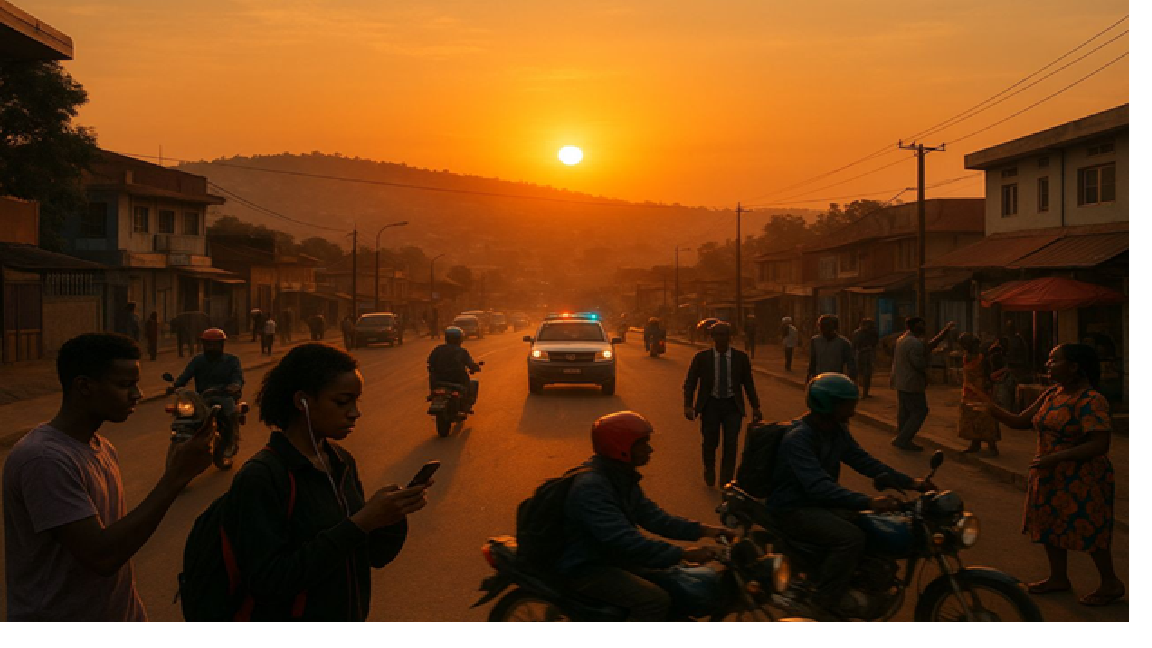
Good morning, Kigali. The sun spills
over the Gisozi hills, turning red clay and concrete into molten gold.
Teenagers snap the sunrise, streaking it across group chats, while others
doom-scroll through TikTok, earbuds in, oblivious to the world or acutely aware
of it all at once. Mobile money notifications ping like morning birds, people
check balances, hoping for a surprise message saying “received.” Electric
motorbikes weave past in neat chaos, RDB workers in suits balancing laptops and
helmets, Kimironko vendors shouting prices, neighbors tossing greetings across
fences. A sudden roadblock parts the Gisozi streets for the President’s convoy;
bikes swerve, red and blue lights flash, everyone caught between awe and
curiosity. Cafés fill with chatter and caffeine, the scent of fresh croissants mingling with exhaust, and somewhere a vuba
vuba delivery rider zips past, headphones in, balancing a stack of parcels
while checking orders on their phone.
But not long ago, mornings like this
were unimaginable. Streets were silent or haunted by whispers, not with
chatter, music, or commerce. Schools, clinics, and markets barely functioned,
if at all, and many public facilities had been destroyed or abandoned. Families
moved cautiously, often hiding, scavenging, or fleeing, while trust between
neighbors had been shattered. Children did not walk freely to school; they
watched adults with suspicion and fear. Streets were filled with dogs feeding
on human remains, and some people drank heavily to numb the pain that had
seeped into every corner of their lives. Markets were empty, water and food
scarce, and medical care almost nonexistent. The city itself seemed frozen,
suspended between survival and collapse, as the work of rebuilding not just
infrastructure but social cohesion began in fragments, in hidden courtyards and
improvised shelters. Peace then was not a given; it was a daily negotiation
against chaos, scarcity, and the trauma that lingered in every corner.
Rwanda hums with a fragile order. Peace here
is not still, not guaranteed, not neat. Local councils mediate quietly,
performance contracts keep officials accountable, youth initiatives stir
participation. Stability is negotiated in every glance, every transaction,
every choice. Opportunities flicker. Trauma whispers in corridors, in homes, in
classrooms. The past lingers not as memory alone but as the backdrop against
which life is measured.
Peace is a dynamic, contested condition
sustained through both formal institutions and social cohesion. It is never
permanent and is continuously tested by inequality, historical grievances, and
systemic shocks. Economic volatility, environmental crises, and regional
conflicts challenge its durability, requiring constant adaptation. Governance,
transparency, and citizen participation are necessary, yet informal networks
and dialogue remain equally vital. As H.E Paul Kagame notes, “Peace is not a
gift; it is a responsibility that must be claimed and safeguarded every day.”
Ultimately, peace is less the absence of conflict than the presence of
resilient, adaptive systems capable of managing tension constructively.
So even without overt protests,
sanctions, or political upheaval, peace is tested daily. Seasonal floods in
Nyabihu and landslides in Rubavu displace families, internal migration fills
Kigali’s rental markets, crop failures hit potato and maize farmers, and unrest
in eastern Congo disrupts cross-border trade and pushes up prices. These
pressures do not explode but rather simmer, nudging neighbors, officials, and
citizens into constant recalibration, like coordinating shelter after a flood,
rationing water during dry spells, or resolving market disputes. Every
arrangement, every compromise…..sharing scarce resources, adjusting harvest
expectations, reorganizing transport is a small act of vigilance.
Trust itself is negotiable.
Survivors and descendants of perpetrators share schools, markets, and bus
stops, navigating memory in silence and conversation alike. Programs like Ndi
Umunyarwanda and Umuganda are threads in a vast, living experiment of coexistence,
yet the work is never done. Youth employment initiatives, community governance
and local dialogues all hum with possibility and tension at once. Peace is
the ability to move through life, to transact, to speak, to listen, without
tipping the balance too far. It is never abstract; it is felt in the
weight of everyday choices, in the economy of small gestures, in the quiet
maintenance of trust.
Evening settles over Kigali. Trucks
begin to move again, motor bikers drift off to sip beers at local bars, vendors
retreat to corners of the city rarely seen, children brush their teeth,
yawning, ready for bed, and the vuba vuba delivery rider cancels an order
because the destination is too far. The hum of the city softens, streetlights
glow along the streets, and the chaos of morning melts into a quieter,
deliberate rhythm. Kigali exhales, its peace neither perfect nor guaranteed,
but maintained in every small act, every compromise, every careful negotiation.
Tomorrow will bring its own movement, its own adjustments, and the ongoing,
uncelebrated labor of living together.
And as the city began to
stitch itself together for a new morning, one could ask: in a place where
silence once devoured the living, can laughter ever truly reclaim the corners
it abandoned, or does it always carry the shadow of what was? Good
morning,Kigali